抱歉,未找到符合的結果。

請嘗試使用不同或更廣泛的關鍵字。

製造
下載

How the APEX-A100 Edge AI System and LAN Module Enable Intelligent Fabric Cutting

簡介

As technical fabrics become increasingly sophisticated, manufacturers face growing pressure to improve cutting precision, material utilization, and production efficiency. This is especially challenging when processing stretchable materials for sportswear and automotive interiors, where material characteristics, complex cutting requirements, and inefficient layouts can directly affect production costs and product quality.

A leading European textile manufacturer adopted a customized Innodisk APEX-A100 Edge AI System and 10GbE LAN module for its automated cutting equipment. The upgrade added more computing power and connectivity to the cutting process, helping the company cut material waste, boost production efficiency, and stay more cost-competitive.

案例背景
IndustryManufacturing
End-Use ScenarioAI Fabric Cutting Machine
RegionEurope
Innodisk Solution

APEX-A100 Edge AI System (with customization)

EGPL-T203 LAN Module


Customer Profile

This European manufacturer specializes in stretchable technical fabrics for sportswear and automotive interiors. Working with highly elastic materials and increasingly complex product designs, the company depends on advanced cutting technology to maintain precision, maximize material utilization, and keep production running efficiently. With a strong focus on cost efficiency and product quality, the manufacturer continues to build on its production capabilities to stay competitive.

挑戰
  • Weak connectivity limits factory-wide integration

    Traditional cutting machines often work in isolation, without much connection to other machines or factory systems. This makes it hard to share production data, coordinate workflows, and stay informed across each stage of production, which lowers overall manufacturing efficiency.

  • Highly elastic fabrics can deform easily during cutting

    Unlike regular textiles, highly stretchable fabrics can easily shift, stretch, or lose their shape while being cut. Differences in material tension, cutting direction, speed, and how multiple layers are handled can all affect consistency, making it hard for standard systems to stay precise on complex production runs.

  • Conventional cutting systems generate excessive material waste

    These systems often struggle to use available fabric efficiently, leaving gaps between cutting patterns and wasting material. For high-value technical textiles, even small inefficiencies can add up to a significant increase in production costs.

解決方案

Innodisk’s modular portfolio covers five technology layers — compute, memory, storage, sensing and communication, and software. By combining these technologies into complete Edge AI Systems, Innodisk helps customers speed up AI deployment while simplifying system integration. Built for flexibility, these systems offer configurable components and tailored customization services to support a wide range of AI applications in advanced textile manufacturing.

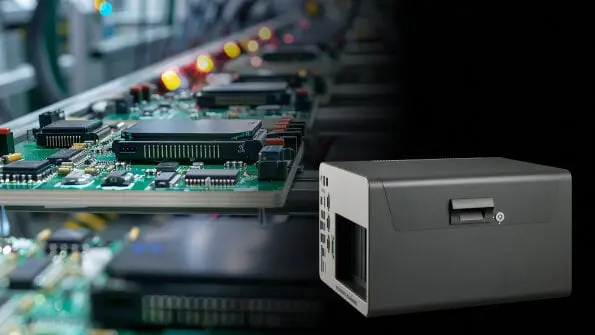
The manufacturer integrated a customized Innodisk APEX-A100 Edge AI System and EGPL-T203 10GbE LAN module into its automated cutting machines, giving the system the computing power and connectivity it needs for advanced textile processing. Powered by the Qualcomm Dragonwing™ IQ-9075 SoC, the APEX-A100 delivers up to 100 TOPS (Dense) of AI performance in a compact, fanless design, while the EGPL-T203 adds dual 10GbE connectivity through a space-efficient M.2 form factor. Together, these two components give the cutting system the power to handle increasingly complex processing tasks.

Key Specifications

APEX-A100  Edge AI System                  

Processor

CPU: Qualcomm Dragonwing IQ-9075 SoC

AI Accelerator

100 TOPS (Dense) / 200 TOPS (Sparse) via 2 × Hexagon Tensor Processor

Expansion

M.2 Slot: 1 × M.2 2242/2280 M Key, PCIe Gen4 x4 (support LAN module)
Display Port: 2 × DP & eDP (support HMI and displays)

Industrial Reliability

Vibration & Shock Resistance: 3G vibration / 30G shock

Wide-Range Power Input: 9–36V DC inpu

What Makes It Different

AI acceleration built into the SoC for a compact, fanless system.


EGPL-T203 LAN Module

Module Type

M.2 2280 to Dual 10GbE LAN Module

Input I/F

PCIe Gen 4 x2

What Makes It Different

World’s first dual-port 10G LAN module in M.2 form factor.

Connected cutting for smarter production

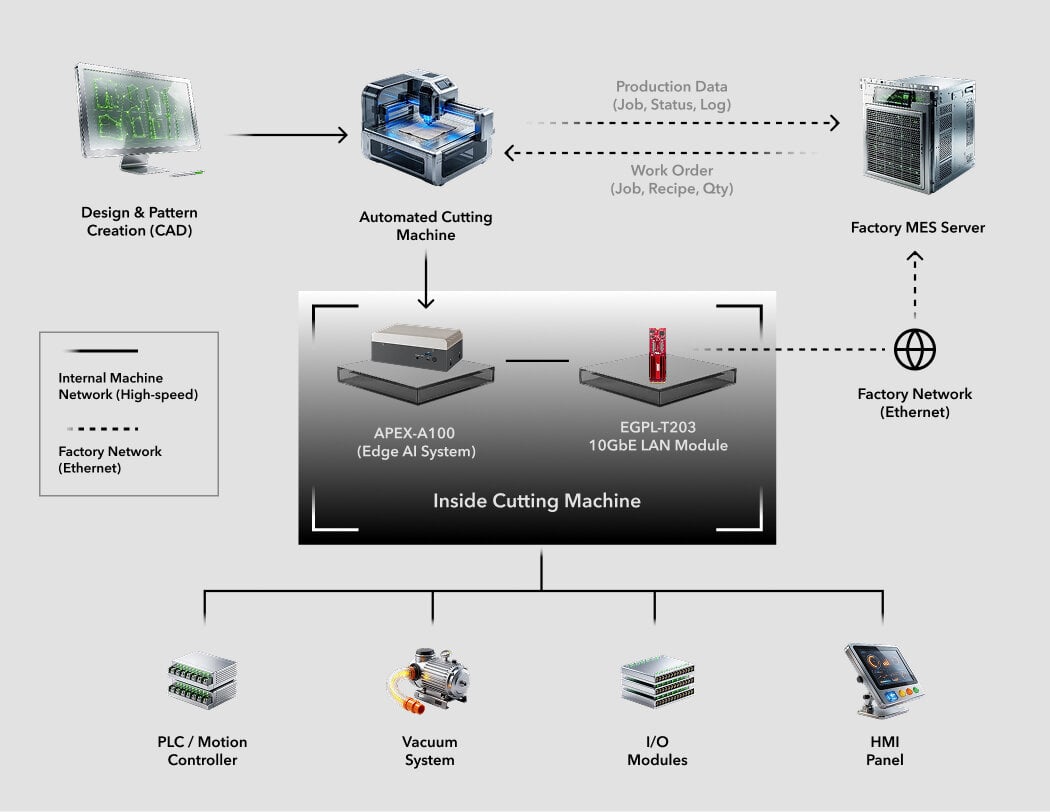
As textile manufacturing becomes increasingly digital, automated cutting machines are evolving from standalone equipment into connected production nodes. Through the HMI (Human-Machine Interface), operators can load cutting jobs, adjust production settings, and monitor machine status, while the cutting system carries out the corresponding production tasks.

By connecting the cutting system with the Manufacturing Execution System (MES), work orders can flow directly from production planning to the machine, while production status is reported back to the factory system. This closed-loop communication helps manufacturers coordinate multiple machines, respond faster to production issues, and cut down on manual handoffs across the factory floor.

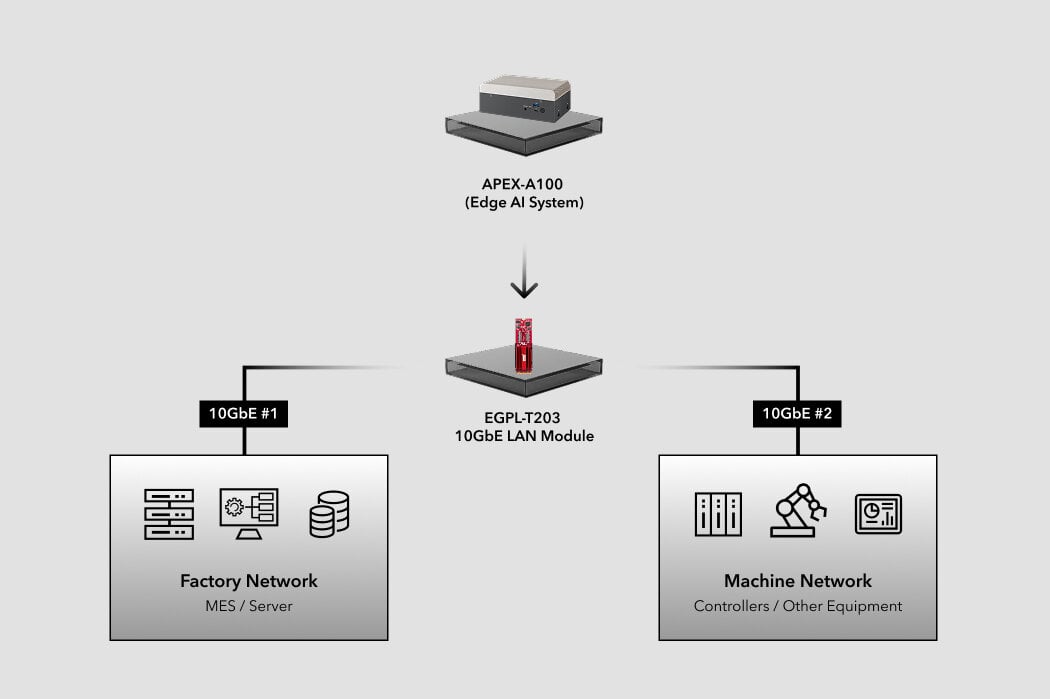
Integrated into the cutting system, Innodisk’s EGPL-T203 provides dual 10GbE connectivity through a compact M.2 2280 design. Its PCIe Gen4 x2 interface connects directly to the APEX-A100’s M.2 PCIe expansion, adding high-speed networking without a bulky add-in card. This compact design fits space-constrained industrial equipment while giving it the network expansion needed to link machine-level operations with MES and the wider factory network.

Precision control for highly elastic fabrics

Before physical cutting begins, Computer-Aided Design (CAD) software turns the product design into digital patterns, defining the shape and dimensions of each part. The cutting software then converts these patterns into cutting paths the machine can execute, factoring in material properties and cutting parameters. For highly elastic technical fabrics, this process has to consider not only the visible patterns and textures but also the material’s stretch direction, since elasticity can vary by orientation.

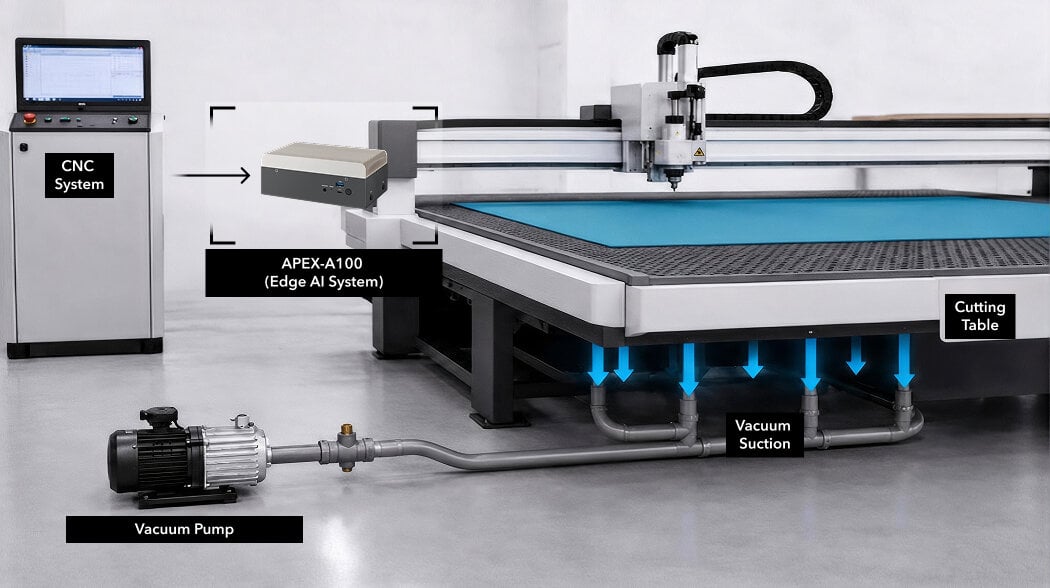
The Computer Numerical Control (CNC) system then carries out these digital cutting paths by controlling the machine’s movements. Because highly elastic fabrics can stretch or shift as the cutting head moves, a vacuum system beneath the cutting surface holds the material firmly in place on the cutting table, while cutting force and speed are carefully controlled to minimize pulling and distortion. For higher throughput, manufacturers can also stack and cut multiple layers at once, which calls for even tighter coordination of cutting force, speed, and vacuum pressure to keep results consistent across every layer.

To support these increasingly demanding cutting processes within limited machine space, Innodisk customized the APEX-A100 around the customer’s specific mechanical footprint and internal layout requirements. Powered by the Qualcomm Dragonwing™ IQ-9075 SoC, the platform integrates CPU, GPU, and dedicated AI acceleration within a single architecture, delivering up to 100 TOPS (Dense) of AI performance. This integrated design delivers strong on-device AI capability without needing a separate accelerator chip, giving equipment manufacturers more flexibility to run advanced AI workloads directly at the edge.

Optimized nesting for maximum material utilization

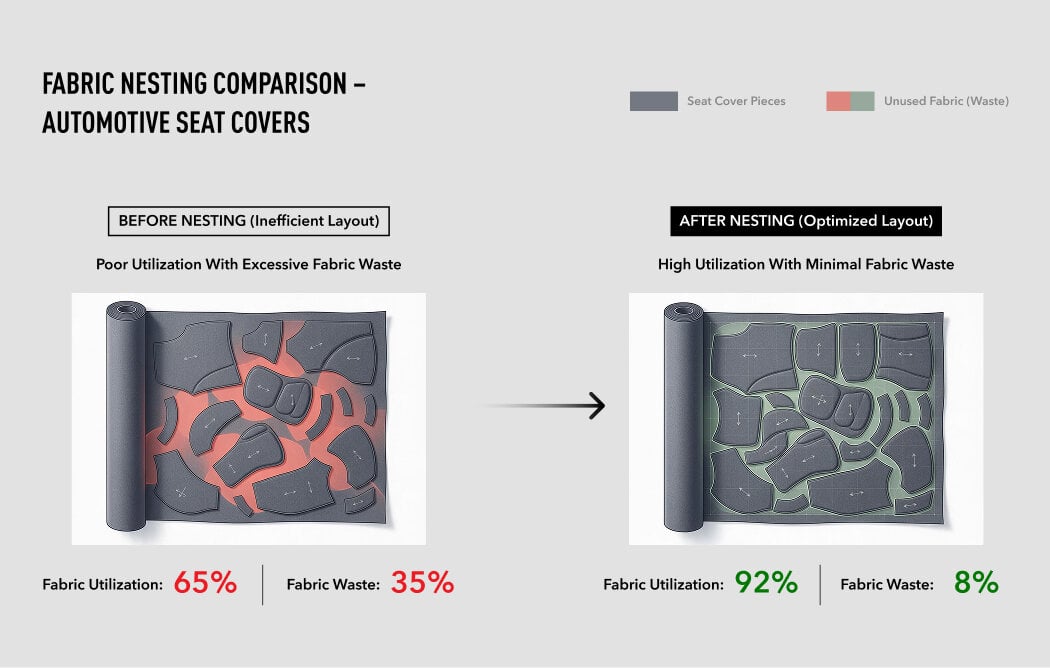
To minimize fabric waste, modern cutting systems use nesting, a process that automatically arranges multiple cutting patterns within the available fabric area to maximize material utilization. Rather than simply packing patterns as tightly as possible, the system weighs different shapes, sizes, quantities, and allowed orientations, while factoring in constraints like stretch direction, pattern orientation, and cutting clearance. By working out a more efficient layout before cutting starts, the system closes the gaps between patterns and gets more parts out of the same amount of fabric.

The APEX-A100 supports up to 36GB of high-bandwidth LPDDR5X memory, giving the system the memory capacity and bandwidth it needs to process complex pattern and layout data during nesting. More efficient layout processing improves material utilization, reducing fabric waste and helping manufacturers control the cost of high-value technical textiles.

導入成果

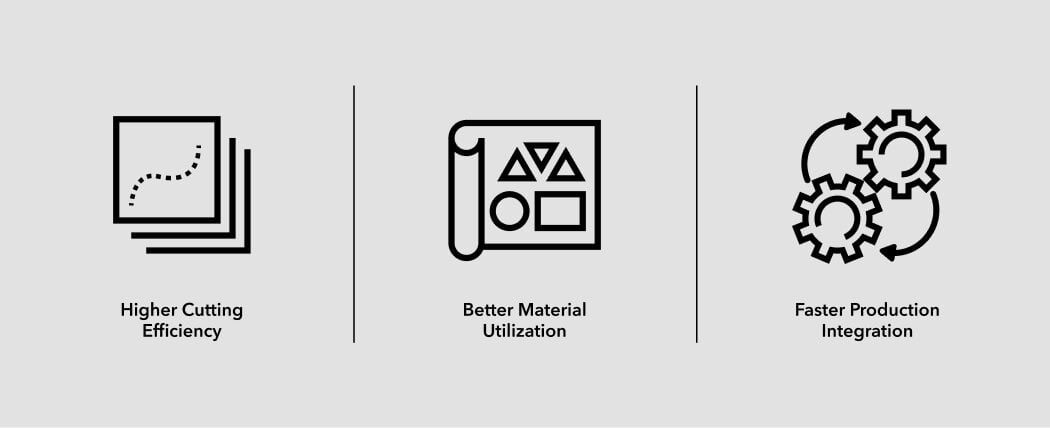
This intelligent cutting system deployment improved both production efficiency and material utilization. More precise control over complex cutting processes boosted cutting efficiency by over 10%, while optimized nesting improved material utilization by more than 10%, reducing waste from high-value technical fabrics.

Better connectivity also streamlined data exchange between cutting equipment and factory systems, cutting down on manual handoffs and improving visibility across the workflow. Together, these gains helped the manufacturer achieve more consistent production, lower material costs, and stronger cost competitiveness.


Disclaimer: The factory layout and content presented in this article are for demonstration purposes only. Due to confidentiality considerations, certain details may be incomplete or differ from actual conditions.

Note: Qualcomm branded products are products of Qualcomm Technologies, Inc. and/or its subsidiaries.

文章分享
載入中...