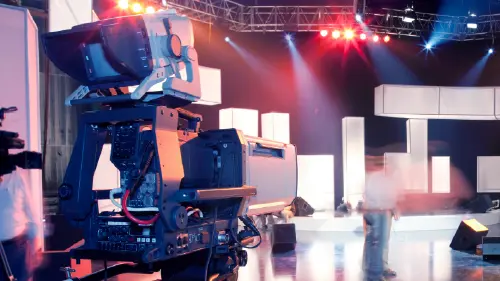
As Fast as the Cars: How Innodisk DRAM and 10GbE LAN Power Real-Time Race Data and Instant Replays
Formula racing is no longer decided by raw speed alone. Today's race teams rely on real-time data to manage engine power, battery energy, tires, and car setup. Off the track, fans expect more from race coverage than ever before: high-definition live broadcasts and exciting slow-motion highlight replays. To meet these expectations, broadcasters rely on advanced broadcast cameras that turn split-second action into clear live images and replays.
This case study brings together two customer applications in modern motorsport. A European racing car manufacturer selected Innodisk's 32GB DDR4 Wide Temperature RDIMM for the onboard computer that records and processes the car's real-time data, while a leading Asian high-speed camera manufacturer adopted the EGPL-T103 M.2 10GbE LAN module to move replay footage faster from the camera to the broadcast system.
| Industry | Entertainment |
| End-Use Scenario | Real-time race car data recording; high-speed sports broadcasting |
| Region | Europe; Asia |
| Innodisk Solution | DRAM Module: 32GB DDR4 Wide Temperature RDIMM with conformal coating & rugged clips LAN Module: EGPL-T103 M.2 2280 to Single 10GbE LAN Module |
Customer Profile
European Racing Car Manufacturer
The customer is a European racing car manufacturer that supports a professional formula racing team. A modern race car is packed with sensors and control units, and onboard chips run complex calculations every second to track the engine, battery, brakes, and tires. A data logger collects and processes this real-time data so race engineers and strategists can make quick decisions during the race and fine-tune the car afterward. Reliable onboard computing is essential from the first practice lap to the final lap.
Leading Asian High-Speed Camera Manufacturer
The customer is a leading Asian manufacturer of high-speed camera systems that capture motion standard broadcast cameras can miss. Today's fans want to see every key moment live and replayed almost instantly, so capturing sharp images is no longer enough: high-speed cameras must also send large amounts of footage to the broadcast system within seconds. Fast, reliable networking has become a new must-have for high-speed cameras, and race officials also rely on this footage to review fast-moving incidents.
Unstable onboard computing puts race strategy at risk
The racing team must decide when to push, when to save energy, and when to pit. These decisions rely on onboard chips and memory that capture and process data from hundreds of sensors without a single gap. If the data logger becomes unstable, the team loses the information its entire race strategy depends on.
Consumer-grade memory struggles with heat and vibration
Inside a race car, electronics face constant vibration at high speed and heat from the engine and power electronics. Standard consumer-grade DRAM is not built for these conditions and can become unstable or work loose, interrupting the data logger. For strategists who have only seconds to make a call, even a short interruption makes decisions harder.
Late replays and signal drops frustrate viewers and sponsors
Fans want to see a decisive overtake or a photo finish again right away. But high-frame-rate clips contain huge amounts of image data, and if they reach the broadcast team too late, the moment has passed. Sponsors care just as much: every second their logos are on screen has value, so any delay or signal drop during live coverage means lost exposure.
Bulky hardware limits where camera crews can work
Camera crews need to place cameras in tight spots around the track and set up quickly at every new circuit. Bulky network cards, external adapters, and messy cabling make camera systems larger and harder to install, limiting camera angles and slowing down setup in already crowded broadcast rooms.
DRAM: Stable Memory for Smarter, Data-Driven Race Strategy
Innodisk's DRAM lineup includes memory solutions ranging from DDR and SDRAM to CXL modules, designed to deliver high bandwidth, low latency, and consistent performance across AI, industrial, and other demanding environments.
DDR is the most widely used memory technology today, found in everything from servers and factory equipment to vehicles. Innodisk offers wide-temperature options together with value-added features such as anti-sulfuration, side fill, rugged clips, and heat spreaders for the most demanding applications.
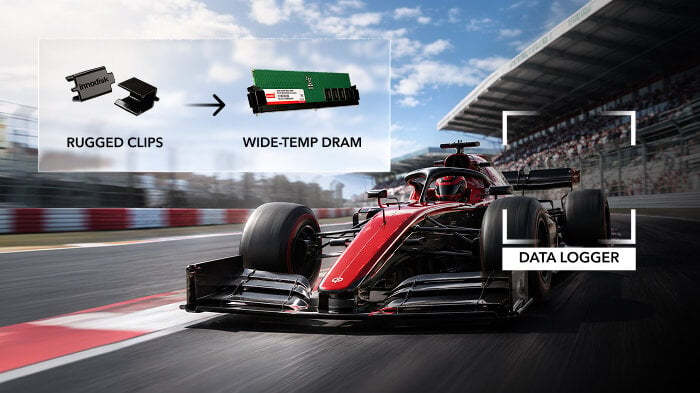
Inside a race car, the two biggest risks for memory are constant temperature changes and non-stop vibration. Wide-temperature DDR4 and rugged clips are designed to handle both. The racing car manufacturer integrated Innodisk's 32GB DDR4 Wide Temperature RDIMM into its onboard data logger.
Key Specifications 32GB DDR4 Wide Temperature RDIMM • Capacity: 32GB • Speed: DDR4 3200 • Function: Registered Memory with ECC • Bus Width: x72 • Voltage: 1.2V • Operating Temperature: -40°C ~ 95°C (Tc) What Makes It Different • Industrial-grade validation for stability and performance • Available with conformal coating, anti-sulfuration, and proprietary rugged clips
 |
Why does a race car need powerful chips and memory? Modern racing has become a constant exercise in energy and resource management. Every lap, the team must balance fuel use, battery energy recovery and deployment, tire wear, brake and engine temperatures, and the timing of pit stops. Lap-by-lap data shows where the car gains time, when the driver can use extra energy to overtake, and when it is better to save resources.
The onboard data logger records signals from the car's sensors and control electronics, including the engine, battery, throttle, brakes, gearbox, and suspension. Alongside live telemetry (data sent wirelessly from the car to the team), these records help strategists make real-time decisions during the race, and selected values also appear on the driver's steering-wheel display. To do this reliably, the data logger needs memory that never misses a beat.
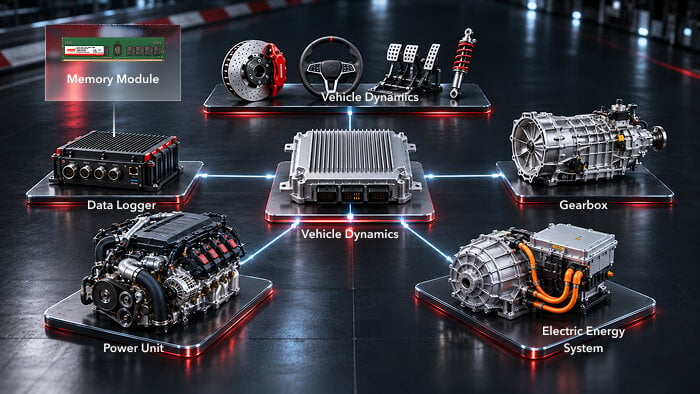
Heat is the first challenge. The data logger is shielded from direct engine and exhaust heat, but the engine, power electronics, and limited airflow still push up the temperature around it. Innodisk's 32GB DDR4 Wide Temperature RDIMM is built for these conditions, running stably from -40°C to 95°C (Tc), so data keeps flowing even when the car is at its hottest.
Vibration is the second. Every time the car rides over the kerbs (the raised strips at the edge of corners), touches another car, or hits bumps on the track, the electronics inside are shaken hard. Innodisk's proprietary rugged clips clamp onto both sides of the DIMM slot and reinforce the standard latches, keeping the module firmly in place without touching the DRAM components.
LAN Module: High-Speed Footage Transfer for Instant Replays
Innodisk Embedded Peripheral (EP) includes a range of networking and I/O expansion modules designed for machine-to-machine and machine-to-device communication, each serving specific connectivity needs.
LAN (Local Area Network) is a wired network that lets devices share data, either within the same system or across different systems. For a high-speed camera, the LAN connection handles camera control, monitoring, and the transfer of recorded clips to the broadcast production or replay system.
The camera manufacturer integrated Innodisk's EGPL-T103 M.2 2280 to Single 10GbE LAN Module into its high-speed camera platform to create a fast, compact link between the camera and the broadcast system.
Key Specifications • Form Factor: M.2 2280 B+M Key • Interface: PCIe Gen4 x2 • Speed: 10GbE (single-port RJ45) • Controller: Intel E610-XAT • Operating Temperature: 0°C ~ 70°C (Ta) • Vibration: 5G@[7~2000Hz] What Makes It Different • Innodisk's lowest-power and smallest 10GbE expansion solution • Supports DPDK, PTP, and SR-IOV for low-latency, precisely timed multi-camera workflows
 |
Why does a broadcast camera need such a fast network? Top-level formula racing is among the world's most-watched sports, often named alongside the Olympic Games and football's World Cup. It is also one of the most commercial: sponsor logos appear on cars, drivers, and trackside boards in almost every second of coverage. Broadcast rights have become so valuable that even major technology companies from outside motorsport now pay heavily to secure them in key markets such as the United States.
Real-time delivery is the first challenge. Covering a race takes well over a hundred cameras around the circuit, in the pit lane, in the air, and on the cars themselves, so dozens of lenses can follow the same car over a single lap. With so many fans and sponsors watching, any signal drop or delay is a serious problem. High-speed cameras must capture cars moving at more than 300 km/h, record key moments at very high frame rates, and send those large clips to a replay server within seconds. The data has to move just as fast as the cars.
Powered by the Intel E610-XAT controller, the EGPL-T103 connects through PCIe Gen4 x2 and delivers a single 10GbE RJ45 port, giving the camera the bandwidth to send slow-motion clips to the replay system quickly. Support for Precision Time Protocol (PTP) keeps timing precise across multiple cameras, so replays from different angles line up correctly.
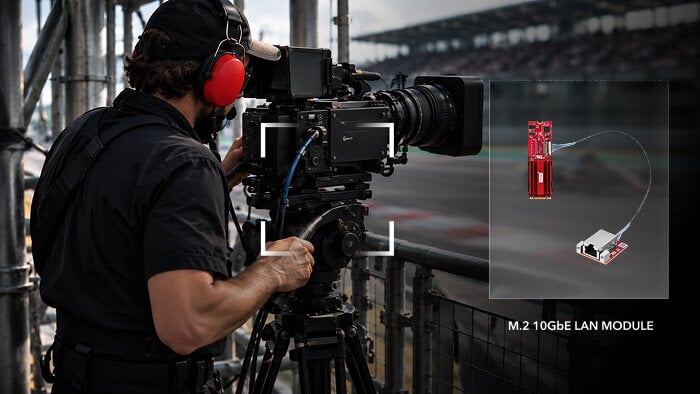
Tight space is the second. Camera bodies and broadcast rooms leave little room for bulky network cards and complex wiring. The EGPL-T103 adds 10GbE without that complexity: the 22 × 80 mm M.2 board connects to a small daughterboard through a single high-speed shielded cable, so the Ethernet port can sit wherever the camera enclosure has room. With no full-size network card or extra adapters, camera crews can use smaller cameras in tight trackside positions and set up faster in compact broadcast rooms.
Both deployments improved the experience on and off the track. On the track, the wide-temperature DDR4 RDIMM keeps race data stable and complete, so strategists can make confident calls on the pit wall. Off the track, the EGPL-T103 helps broadcasters deliver slow-motion replays faster and keep live coverage running smoothly for fans around the world.
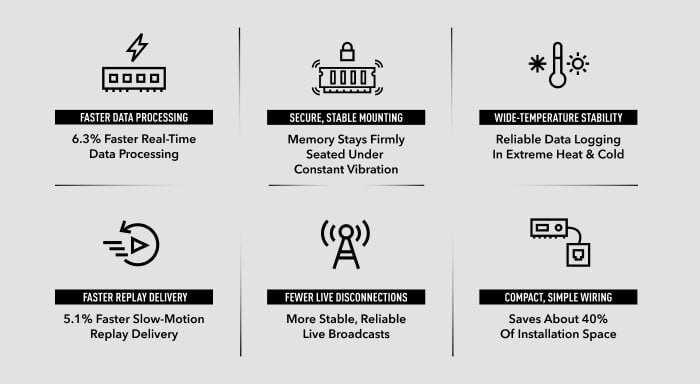
From the race car to the broadcast room, Innodisk's DRAM and LAN modules help racing teams and broadcasters keep data and footage moving at race speed.

Disclaimer: This case study combines two separate customer applications in professional motorsport. Customer names and certain system details have been omitted or generalized for confidentiality. The products described were deployed in different systems and should not be interpreted as components of a single race car or broadcast platform. Results are based on customer feedback and may vary by system configuration.
왜 INNODISK인가?
Innodisk는 협력을 통해 모든 난제를 극복할 수 있다고 믿습니다. 문의부터 구현에 이르기까지 긴밀한 커뮤니케이션 라인을 유지함으로써 고객의 애플리케이션에 맞는 맞춤형 솔루션을 보장합니다. Innodisk 는 하드웨어, 펌웨어, 소프트웨어 통합에 지속적으로 집중하며 혁신을 위해 최선을 다하고 있습니다.