
Behind the Scenes of a Safe Departure: How Innodisk’s Modules Strengthen Pre-Flight Reliability
Innodisk’s solutions operate quietly behind the scenes, proving that small components can have a significant impact on aviation safety and reliability.
Aviation safety is built on thorough pre-flight preparation and the lessons learned from past shortcomings. In flight-safety investigations, the “black box” that captures critical flight data relies on rugged flash storage engineered to withstand the aircraft’s demanding operating conditions. In parallel, aircraft maintenance operations depend on high-speed DRAM to accelerate digital-twin workflows that ease technician workload and shorten turnaround time. And in pilot training environments, full-motion simulators rely on LAN modules to move real-time data across motion systems and visual engines, keeping every element precisely in sync.
Industry | Aviation |
End-Use Scenario | Black Box Systems, Maintenance Digital Twins, Flight Simulator |
Innodisk Solution |
|

Customer Profile
Aviation OEMs
Modern aircraft depend on multiple specialized manufacturers. Beyond the airframe and primary structure, every major subsystem—flight computers, data recorders, in-flight entertainment systems—is supplied by dedicated OEMs, each bringing domain expertise to their respective components.
Aircraft Maintenance Company
Maintenance, Repair, and Overhaul (MRO) providers perform the routine inspections, component replacements, troubleshooting, and system checks that keep aircraft airworthy. These organizations increasingly rely on advanced modeling tools such as digital twins to streamline complex maintenance workflows, reduce aircraft downtime, and improve diagnostic accuracy for sophisticated systems.
Flight Simulator Manufacturer
Unlike consumer-grade entertainment simulators, full-motion flight simulators are precision training systems used for pilot certification and recurrent training. They require high-bandwidth, low-latency data exchange to accurately replicate real-world conditions, aircraft behavior, and emergency scenarios. This level of fidelity demands robust computing, networking, and precise synchronization across multiple subsystems.
Harsh Requirements for Flight Recorders
Black boxes are well-known flight recorders that log instrument readings, cockpit audio, and crew conversations for incident investigations. Mounted near the aircraft tail, black boxes must withstand constant vibration, pressure changes, temperature swings, and power instability while maintaining uninterrupted data recording throughout every flight—demanding exceptional component reliability.
Long and Costly Aircraft Maintenance Cycles
Replacing or inspecting an engine can take up to four hours just to install (or remove) the component. If an issue goes unnoticed during reassembly, technicians must repeat the entire cycle, consuming time, labor, and valuable ramp space. This directly impacts MRO workflows, turnaround schedules, and overall fleet availability. Even more, some cracks or deviations are nearly impossible to detect by eye and can take significant time to locate, further complicating maintenance operations.
High-Complexity, Zero-Latency Demands in Full-Motion Flight Simulators
Full-motion flight simulators are more complex than fixed-base trainers. Physical movement requires processing higher signal volumes, synchronizing multiple subsystems, and managing motion cues in real time. Any latency or data mismatch disrupts immersion and degrades training quality, making signal stability critical for manufacturers.
Flash Storage: Uninterrupted Data Recording Under Extreme Conditions
Innodisk’s Flash product portfolio includes a wide range of industrial-grade storage solutions in M.2, U.2, and EDSFF form factors, designed for high-reliability data logging, secure data retention, and long-term operation across diverse applications.
The M.2 interface is an industry-standard design that delivers high-performance PCIe-based storage in a compact footprint. Its streamlined connector, minimal cabling, and efficient power design make it ideal for embedded systems and edge devices where board space, thermal management, and reliability are paramount.
Key Specifications
What Makes It Different
|
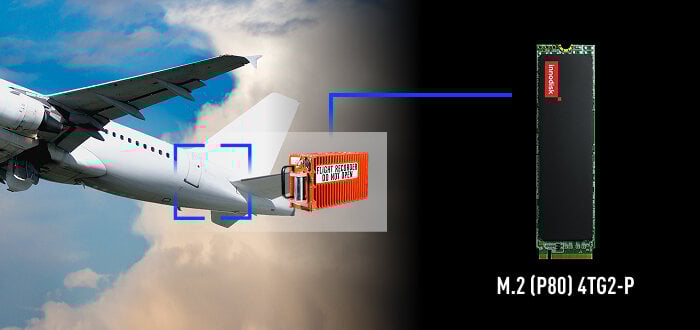
M.2 (P80) 4TG2-P is engineered specifically for demanding applications such as flight recorders. The module supports vibration resistance of 20G @ [7–2000 Hz], enabling reliable performance under constant aircraft vibration. Its –40°C to 85°C operating temperature range and thermal throttling features, help maintain data integrity amid significant temperature swings encountered during ascent, cruise, and descent.
To address fluctuations in power stability, the drive integrates PLP (iCell), which provides additional power-loss protection to safeguard in-flight data. Continuous recording reliability is further reinforced by advanced flash technologies such as Die RAID, which enhances fault tolerance, and AES-256 with TCG Opal 2.0, which ensures secure, recoverable data for post-event investigation. These capabilities collectively support the uninterrupted data logging required by FDR and CVR systems operating across long flight durations.
DRAM: Accelerating Digital-Twin Maintenance Workflows
Innodisk's DRAM lineup includes robust memory solutions ranging from DDR and SDRAM to CXL modules, all designed to deliver high bandwidth, low latency, and consistent performance across AI and industrial environments.
DDR modules remain the most widely deployed in industrial systems. As edge AI adoption accelerates, the market continues to rely on mature DDR4 solutions, while DDR5 is increasingly adopted for higher-performance applications. Innodisk introduces the industry's first DDR5 7200 RDIMM as a significant enhancement to its DDR5 series, further advancing innovation across embedded platforms and edge AI deployments.
Key Specifications
What Makes It Different
|
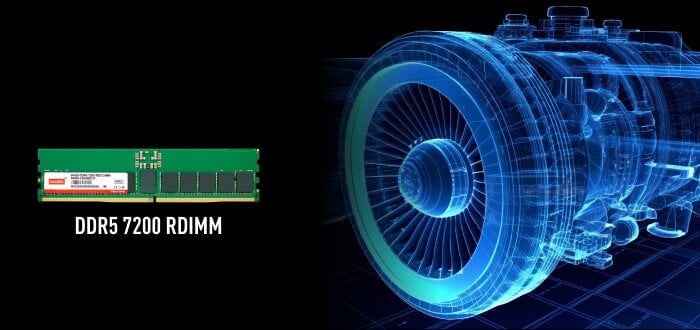
The DDR5 7200 RDIMM provides the high-speed memory required for rapid digital-twin modeling during engine inspections, where routine checks must be completed within hours to maintain flight schedules. Its 7200 MT/s throughput—a 12.5% performance increase over previous generations—enables detailed aerodynamic and physics-based simulations to run efficiently, helping technicians identify micro-cracks or misalignments that visual inspections may miss.
With densities up to 64GB, the module supports larger and more complex simulation models, enabling digital-twin systems to process high-resolution data without bottlenecks. This speed and memory capacity allow digital-twin platforms to serve as effective post-repair verification tools, enabling technicians to confirm component health before reinstalling engines and avoiding costly removal-and-install cycles.
The module's wide-temperature tolerance ensures reliable operation inside maintenance hangars, supporting consistent performance across varying ambient conditions and helping aircraft return to service without operational delays.
LAN Modules: Real-Time Synchronization for Flight Simulators
Innodisk Embedded Peripheral (EP) includes a range of expansion modules designed for machine-to-machine and machine-to-device communication, each serving specific connectivity requirements.
LAN (Local Area Network) is a multi-node wired network that enables data exchange between devices—either within the same system or across different systems—and allows connection to external networks when needed.
Key Specifications
What Makes It Different
|
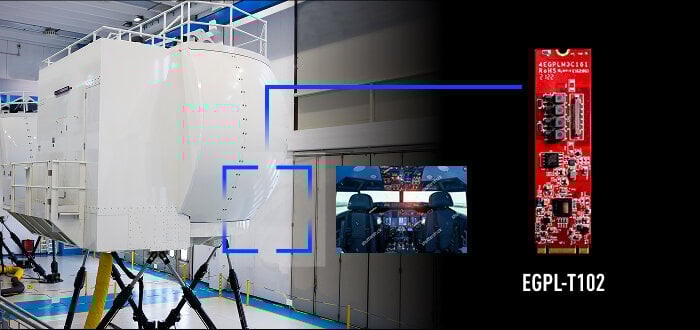
The EGPL-T102 delivers high-speed 10GbE networking that enables real-time visual output inside full-motion flight simulators to appear virtually indistinguishable from actual flight conditions. Its native PCIe Gen 3 ×2 interface provides low-latency, high-throughput data exchange that keeps motion systems, visual rendering engines, and instructor stations operating in precise coordination.
To ensure stable performance on a moving platform, the module supports vibration tolerance of 5G@[7~2000Hz], maintaining reliability even during rapid motion cues. Its thermal-optimized design and support for PTP 1588v2 and AVB enable accurate timing and dependable signal transmission across all subsystems, ensuring smooth motion-to-visual consistency throughout demanding simulator operations.
Many of the efforts that safeguard every flight begin long before takeoff. Innodisk’s industrial-grade modules provide the reliability, performance, and durability that strengthen the foundation of aviation safety from the ground up.
Disclaimer: This article provides simplified illustrations of aviation mechanics and onboard charging equipment. The information does not constitute actual specifications and does not override applicable aviation laws or certified safety standards.
¿POR QUÉ INNODISK?
En Innodisk, creemos que cualquier desafío puede superarse mediante la colaboración. Al mantener una comunicación sólida desde la consulta inicial hasta la implementación, garantizamos una solución hecha a la medida para su aplicación. Seguimos comprometidos con la innovación mediante nuestro enfoque constante en la integración de hardware, firmware y software.